
Iran's Bitcoin Backdoor
Turning Subsidized Electricity into Hard Currency


Markets price war risk into oil immediately but there is another commodity tied to the same infrastructure (electricity and connectivity) that no one talks about. Iran has treated Bitcoin mining as industrial policy under sanctions pressure, with reporting and analysis describing mining as a way to convert constrained domestic energy into cryptoassets that can be used to purchase imports outside traditional rails.
Today’s Creed is Simple:
Bitcoin is a machine that turns electricity + connectivity into hard money
Sanctions don’t stop that machine; they just change who gets to feed it
When a state subsidizes power, mining becomes industrial policy
When war breaks grids and networks, hashrate goes dark
The exact numbers are always foggy, but the dependency chain isn’t
No grid. No internet. No hash.
The Context
On February 28, 2026, the U.S. and Israel launched coordinated strikes on Iran, triggering retaliation and cascading disruption across the region. At the same time, monitoring group NetBlocks reported Iran’s connectivity falling to ~4% of ordinary levels. This is a near-total internet blackout. That internet layer matters because Bitcoin mining is not magic hashing in a cave. It is a constant feedback loop: miners need reliable connectivity to receive work (pool jobs / templates) and submit shares (or broadcast blocks if solo).
Even before you touch the grid question, you’ve got a simple operator thesis:
If Iran goes dark, a meaningful slice of any Iran-based hashrate can go dark with it without a single bomb targeting Bitcoin.
What Iran Actually Built
Iran didn’t just discover Bitcoin mining. It integrated mining into policy.
Multiple analyses describe Iran officially recognizing mining and then routing mined bitcoin into state channels. This is including requirements in the licensing regime that miners sell mined bitcoin to the central bank, with crypto used to pay for imports and lessen the impact of sanctions.
Elliptic’s work argued that at the time of its estimates, Iran’s mining could produce revenues on the order of hundreds of millions to ~$1B annually. That convert sanctioned energy into unsanctioned value logic is the core truth.
The Grid Story
Iran has a long-running electricity strain problem, and illegal mining is regularly cited as a contributor. Iranian officials and major reporting have repeatedly put illegal mining in the hundreds of thousands of devices range, with power draw in the gigawatt ballpark. A widely circulated official estimate is ~700,000 illegal rigs consuming ~2,000 MW. Older coverage also references illegal operations consuming up to ~2,000 MW.
This is why the war knocks out mining by knocking out the grid. It’s exactly how electricity-intensive industries behave under instability.
The Numbers and What They Imply
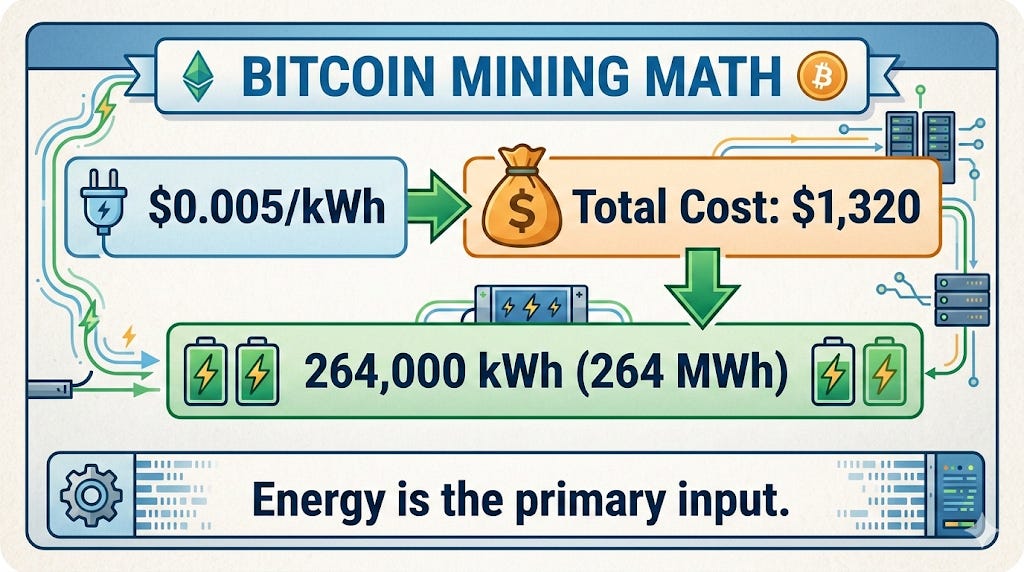
Under extreme subsidy conditions that have been reported for parts of Iran’s grid, power can be priced around $0.005 per kWh. At that rate, an electricity bill of $1,320 implies about 264,000 kWh (264 MWh) consumed (1,320 ÷ 0.005). That simple conversion is why the “Iran mines a bitcoin for $1,320” line exists. It’s not a full cost model; it’s a way of isolating the energy component of proof-of-work and showing how violent the advantage becomes when the state underprices power. In a system where electricity is the primary ongoing input, subsidy math is destiny.
That electricity-only framing is also where the 50x margin idea comes from. If you can convert a few thousand dollars of subsidized power into an asset that can be sold globally at tens of thousands of dollars, mining stops looking like a niche tech activity and starts looking like industrial conversion. The mechanism is the story. Bitcoin is the export.
Then there’s scale. Iranian power-sector estimates that circulate in the public record describe hundreds of thousands of mining devices operating outside the formal licensing regime, with load estimates around ~2,000 megawatts. This is the kind of draw you associate with a mid-sized city, not a hobby. On the device side, figures like ~700,000 illegal rigs have been reported; on the power side, ~2 GW is the number that matters because it connects mining directly to blackouts, rationing, and grid fragility. When a grid is already stressed, a 2-gigawatt shadow industry becomes a first-order political problem.
That same scale is why estimates of Iran’s contribution to global hashrate get attention. If a country sits anywhere in the 2–5% range at a given moment, that’s enough to matter at the margin. It affects global competition, revenue flows, and the sensitivity of mining output to local disruption. The exact share is hard to pin down precisely, but the implication is simple: when a measurable slice of hashrate is geographically concentrated on a fragile grid, geopolitics can show up in the mining layer without anyone targeting Bitcoin at all.
Finally, there’s the political economy. Mining in Iran has repeatedly been discussed as more than private entrepreneurship. In that environment, mining behaves less like a neutral market and more like a strategic revenue pipeline.
Put together, the numbers describe a single structure. Subsidized electricity + constrained access to global finance + industrial-scale mining. The advantage is real, the dependency is obvious, and the vulnerability is built into the same place the advantage lives.
What Happens to Bitcoin if Iran’s Hashrate Drops?
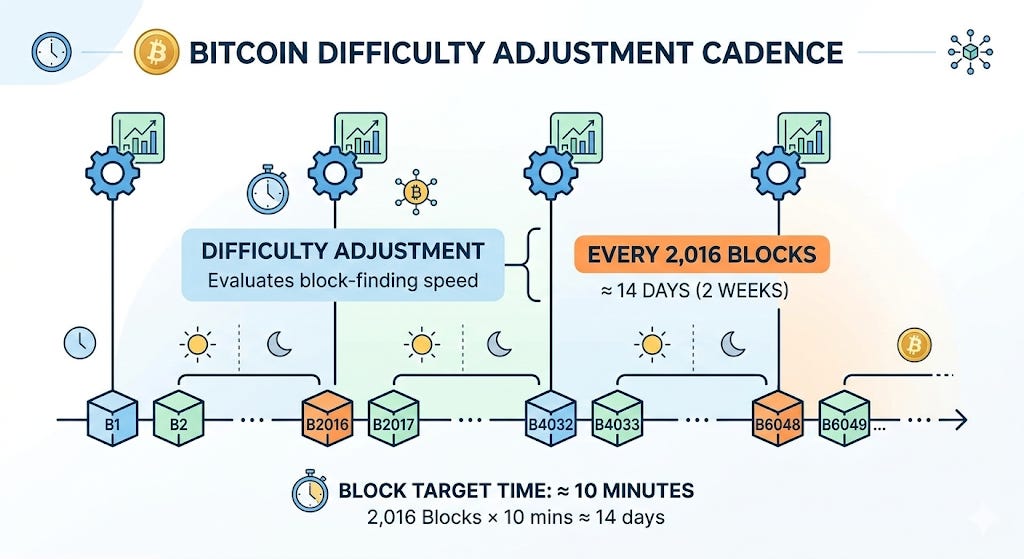
Bitcoin’s difficulty adjusts every 2,016 blocks to target ~10-minute block intervals.
If global hashrate dropped by:
2%, expected average block time rises from ~10.0 to ~10.2 minutes
5%, block time rises to ~10.53 minutes (10 / 0.95)
That’s real, but it’s not apocalyptic. It means blocks come slightly slower until the next difficulty adjustment epoch and fee impact is not automatic: fees rise when demand outstrips blockspace supply; a small slowdown can tighten supply at the margin, but fees spike depends on what users are doing.
The more important market impact is psychological: people price oil war risk instantly; they don’t have a clean mental model for hashrate geopolitics.
Mining Needs Oxygen
Mining runs on continuous power and continuous connectivity. When connectivity collapses, pool miners lose the ability to receive fresh work templates and to submit shares back to the pool, which means hash rate turns into heat with no payout. Solo miners can keep hashing locally for a bit, but without a reliable path to the wider network they can’t propagate blocks fast enough to win against the rest of the world. Even a valid block is worthless if it arrives late and gets orphaned.
This is where the concept of going dark matters. It doesn’t always mean machines are physically off. It means effective hashrate drops because stale work becomes uncompetitive quickly and intermittent connectivity introduces enough latency and packet loss to kill profitability. In proof-of-work, uptime is oxygen.
Three Paths From Here
Scenario A: Temporary Blackout
This is the most common outcome. Connectivity or power drops, hashrate dips, headlines spike, and then the system re-stabilizes. Bitcoin keeps running, block times drift slightly, and the market mostly shrugs once the narrative cycle moves on.
Scenario B: Rolling Outages
This is where it starts to matter operationally. Persistent disruptions mean Iran-based mining (legal or illegal) can’t maintain consistent uptime, which lowers effective hashrate and disrupts cashflow. Blocks come in a little slower until difficulty adjusts, and any mining revenue routed through state channels becomes less reliable in the same period sanctions pressure is still binding.
Scenario C: Infrastructure Degradation
This is the structural shift. Long-lasting grid damage, fuel constraints, enforcement crackdowns, or sustained internet suppression pushes mining out of the industrial conversion lane and into survival mode. Equipment migrates, gets seized, or goes silent. The energy → BTC pipeline weakens, because the foundation it sits on (stable power + stable network) stops being dependable.
What the Market is and Isn’t Pricing
Oil markets have reflexes. They price shipping lanes, insurance premiums, reserve capacity, and the probability of disruption almost instantly. Bitcoin markets are faster than most, but they’re not modeling infrastructure dependencies with the same discipline. They don’t carry a clean mental model for hashrate concentration + grid fragility + connectivity collapse, even though hashrate is literally an energy-and-network derivative.
This doesn’t even break Bitcoin. Bitcoin is permissionless, not geography-less. The protocol keeps producing blocks, difficulty eventually adapts, and miners elsewhere pick up the slack. The real effect is on flows and narratives: which states can monetize energy, which actors lose an off-rails revenue stream, and how quickly the market updates its picture of where mining actually lives.
What to Watch This Week
NetBlocks / connectivity out of Iran: if the blackout persists, effective mining output is likely suppressed.
Block interval + hashrate trend: look for sustained drift, not a single-day wiggle.
Difficulty epoch timing: any hashrate shock matters more if it persists through a meaningful slice of an adjustment window.
Mempool + fees: fees don’t spike automatically. Watch demand versus blockspace.
Iran grid status + fuel constraints: blackouts, rationing, and generation hits are the real choke points.
Official actions: mining bans, enforcement sweeps, or state directives around electricity use change the slope fast.
Final Words
Bitcoin turns electricity into hard money. Under sanctions, that conversion becomes strategy. Under war, the same dependency becomes a vulnerability. Iran’s mining story is not just about rigs, it’s about whether a state can keep the two inputs alive: power and connectivity.
Don’t get trapped in internet certainty. The exact numbers will always be debated. What matters is the dependency chain and the incentives: subsidized energy creates a mining advantage; disrupted infrastructure flips that advantage into a kill switch. Bitcoin won’t die from it. But the actors who depend on that pipeline might.
Enter as a reader; leave as an operator. Subscribe, custody, protect the signal.
-WD
Sources
Strikes + disruption (current events):
- Reuters on strikes/panic: https://www.reuters.com/world/middle-east/us-israeli-attack-triggers-fear-panic-iran-2026-02-28/
- Reuters on Israel “pre-emptive” strike framing: https://www.reuters.com/world/middle-east/israel-says-it-launched-pre-emptive-attack-against-iran-2026-02-28/
- Reuters on cyber operations + internet drops: https://www.reuters.com/business/media-telecom/hackers-hit-iranian-apps-websites-after-us-israeli-strikes-2026-03-01/
- NetBlocks blackout post:
https://x.com/netblocks/status/2027658406127960133
- Washington Post (NetBlocks cited): https://www.washingtonpost.com/world/2026/02/28/israel-strikes-iran-live-updates/
- Wired on hacked prayer app + blackout context: https://www.wired.com/story/hacked-prayer-app-sends-surrender-messages-to-iranians-amid-israeli-strikes
Iran mining + sanctions + grid:
- Elliptic (policy + sanctions): https://www.elliptic.co/blog/how-iran-uses-bitcoin-mining-to-evade-sanctions
- MEI (Iran + crypto mining policy context): https://mei.edu/publication/iran-and-cryptocurrency-opportunities-and-obstacles-regime/
- Iran International / Tavanir estimate (700k rigs, 2,000 MW): https://www.iranintl.com/en/202503093831
- Al Jazeera (illegal mining up to 2,000MW; bans): https://www.aljazeera.com/economy/2021/5/26/iran-bans-all-crypto-mining-after-summer-power-cuts-strike
- TechCrunch (CCAF share drop reference): https://techcrunch.com/2022/06/19/iran-to-cut-electricity-to-authorized-crypto-miners-report/
- CCAF mining map methodology note: https://ccaf.io/cbeci/mining_map
Bitcoin mechanics (difficulty + connectivity):
- Bitcoin developer guide (difficulty at block 2016 context): https://developer.bitcoin.org/devguide/block_chain.html
- Blockchain.com note on 2016-block difficulty adjustment: https://www.blockchain.com/charts/difficulty
- Galaxy report on mining protocols / pool communication: https://www.galaxy.com/insights/research/future-of-bitcoin-mining-protocols
- Stratum protocol overview (Bitcoin Wiki): https://en.bitcoin.it/wiki/Stratum_mining_protocol
- Ledger mining guide (internet stability): https://www.ledger.com/academy/topics/crypto/bitcoin-mining-at-home-a-practical-guide