
Bitcoin's Security Budget is Real. The Panic is Not
Why the subsidy decline matters, but does not justify tail emission, NAT, or fear-based solutions

The Uncomfortable Question Bitcoiners Avoid
What happens when the block reward is no longer enough to pay miners to secure Bitcoin?
That is the question that makes a lot of Bitcoiners uncomfortable. I get why. Most attacks on Bitcoin are lazy. They usually come from people who do not understand proof-of-work, do not understand difficulty adjustment, and honestly do not want Bitcoin to work in the first place. So the natural reaction is to dismiss anything that sounds like another Bitcoin is doomed argument.
But the security budget debate is not imaginary.
Bitcoin pays miners through two sources: the block subsidy and transaction fees. Right now, the subsidy is still doing most of the heavy lifting. The current subsidy is 3.125 BTC per block, and with Bitcoin producing roughly 144 blocks per day, that means miners receive about 450 new BTC per day from the subsidy alone. At roughly $78,033 per bitcoin, that comes out to about $35.1 million per day, or about $12.8 billion per year, before even counting transaction fees (CoinMarketCap, 2026; D-Central Technologies, 2026).
That is not a small number. Bitcoin is not unsecured today. The network is paying miners billions of dollars a year to point real machines, real electricity, real infrastructure, and real operational risk at securing the chain. That is the whole point of proof-of-work. The security is not based on vibes. It is based on making attacks expensive.
But here is where the conversation gets uncomfortable: most of that miner revenue still comes from new issuance, and new issuance is designed to disappear.
That does not mean the next halving destroys the network. It does not mean we need tail emission, bigger blocks at any cost, proof-of-stake, or some secondary token that miners dump for BTC. But it does mean the question is real. Over time, Bitcoin has to transition from a security model mostly paid by the block subsidy to one paid more by transaction fees, price appreciation, energy efficiency, mining innovation, and people actually choosing to participate in the network.
This is where I think there is a real pressure point, but a lot of people lean too hard into fear. Hashrate alone does not tell the whole story. If mining hardware gets cheaper or electricity gets cheaper, then a higher hashrate does not automatically mean the network is proportionally harder to attack. Economic security is not just number go up on a hashrate chart. Proof-of-work security depends on the cost of attacking the chain being large relative to the economic value of attacking it (Budish, 2018). In other words, miner payments matter because they help determine how expensive it is to overpower honest miners.
So yes, the issue is real.
Where I disagree is with the panic framing.
The mistake is acting like the coinbase reward getting cut in half automatically means Bitcoin’s security budget gets cut in half in the real world. It only gets cut in half in BTC terms. If Bitcoin’s price doubles over that same four-year period, the dollar value of the subsidy can stay roughly the same. If fees grow, it can be higher. If mining hardware improves, energy use becomes more efficient, heat gets reused, home mining becomes more normal, or people find new ways to integrate miners into everyday infrastructure, the picture changes again.
That is why I do not look at this as a countdown clock to failure. I look at it as one of the most important long-term questions Bitcoin has to answer.
The honest version is simple. Bitcoin does not have a security crisis today. Bitcoin has a future security-budget transition. That transition deserves serious thought. But serious thought is different from fear mongering.
What the Security-Budget Argument gets Right
Before I push back on the fear, I want to be fair. The security-budget concern gets a few important things right.
First, miner incentives matter. Bitcoin security is not magic. It is not protected by slogans, memes, or people yelling number go up. It is protected because miners are paid to point real hashpower at the network. That means electricity, ASICs, cooling, infrastructure, maintenance, opportunity cost, and risk. If miners are not paid enough, some miners leave. If enough miners leave, the cost of attacking the network changes. That is just how proof-of-work works.
Second, the subsidy decline is mechanical. Bitcoin’s issuance schedule does not care about feelings. The current block subsidy is 3.125 BTC, and that subsidy gets cut in half roughly every four years until new issuance eventually trends toward zero (“Bitcoin’s Security Budget Issue,” n.d.; Czech National Bank, 2025). Right now, 3.125 BTC per block multiplied by roughly 144 blocks per day equals about 450 BTC per day paid to miners from subsidy alone. At about $78,033 per BTC, that equals roughly $35.1 million per day, or about $12.8 billion per year, before transaction fees are even counted.
Third, fees are not currently carrying the system. That part is also true. On April 16–23, 2026 it was estimated that transaction fees made up only 0.59% of total miner revenue for that week (BTC.network, 2026). Using the current subsidy value, that implies only about $208,000 per day in fees compared to roughly $35.1 million per day in subsidy. That is a massive gap. Anyone pretending fees are already replacing the block subsidy is not being serious.
So I do not dismiss the security-budget concern. The math says the concern is real. The subsidy is still dominant. Fees are small. Miner incentives matter. Bitcoin eventually has to make the transition from a subsidy-heavy security model to one where fees, price, efficiency, and broader participation matter more.
But this is where the argument usually goes off the rails.
A real issue does not automatically justify panic. It also does not automatically justify tail emission, changing Bitcoin’s monetary policy, forcing bigger blocks, or creating a secondary token subsidy for miners. The problem is real. The fear narrative is where I start to disagree.
What the Security-Budget Argument gets Wrong or Overstates
The weak claim is not that fees must matter someday. That is true. Eventually, fees have to matter more because the subsidy keeps shrinking. The weak claim is the implied certainty that Bitcoin has no organic path toward solving this without mutating into something else.
That is where the fear starts to feel too narrow.
The argument often gets framed like there are only a few options. Either fees magically replace the subsidy, or Bitcoin has to change its monetary rules, add tail emission, punish dormant coins, increase block space aggressively, or attach some new incentive layer to mining (“Bitcoin’s Security Budget Issue,” n.d.). Some of those options are correctly criticized because they violate Bitcoin’s core promise. Tail emission breaks the fixed supply. Demurrage attacks holders. Burning dormant coins creates a property-rights nightmare. Changing the monetary rules would be a disaster for the exact reason Bitcoin matters in the first place.
But that framing still makes the future look like a closed menu. Either fees save Bitcoin by themselves, or Bitcoin has to mutate.
I do not buy that.
Bitcoin does not need to become Ethereum, Monero, Filecoin, or a dual-token security machine. It does not need a second asset whose whole purpose is to be sold for BTC. It does not need to financialize every possible problem into another token. Bitcoin’s culture is part of its security model. That sounds abstract, but it matters. The missing variable is not only fee pressure. It is also how many people are willing to participate in securing the system even when mining is not a clean industrial ROI spreadsheet.
This is where the lottery miner matters.
A home miner is not trying to beat a public mining company on cost per terahash. That is the wrong comparison. A home miner may be mining because it heats a room, because it teaches them the network, because they want to point hash at their own node, because they want a lottery ticket at a block, or because they believe Bitcoin should not be secured only by giant industrial farms and centralized pools.
That kind of miner is hard to model because it is not purely financial. But Bitcoin itself was not bootstrapped by people running perfect spreadsheets. It was bootstrapped by weirdos, hobbyists, ideologues, cypherpunks, and people willing to run software before the incentive was obvious.
That is why I think the fear framing misses something important. Bitcoin’s future security budget is not just a math problem about the coinbase reward. It is also a participation problem. It is about fees, yes. But it is also about price, hardware, energy, heat reuse, open-source ASICs, full nodes, mining pools, block-template construction, and whether normal people can still participate.
The future of Bitcoin security should be more Bitcoiners directly involved in securing Bitcoin.
A Miner Reward is Only Real if Someone Wants the Asset for its Own Sake
This is where I really start to disagree with the proposed second subsidy style solutions.
A secondary asset whose main job is to be sold for BTC is not a real security solution. It is a speculative subsidy.
DMT-NAT is being promoted as a Bitcoin-native secondary miner reward. The basic idea is that NAT is generated with Bitcoin blocks and distributed to miners as an additional reward on top of the normal BTC block reward. NAT’s own site describes it as a “second miner subsidy” designed to address Bitcoin’s declining security budget, and CoinMarketCap describes NAT as a token where each Bitcoin block creates a corresponding allocation that is distributed to the miner of that block (“DMT-NAT,” n.d.; CoinMarketCap, 2026). Some mining pools have also started supporting NAT rewards, with f2pool explaining that NAT rewards are calculated separately from BTC rewards and paid out through a separate NAT payout address (f2pool, 2026).
On paper, I understand why people find this interesting. It sounds clean. Bitcoin miners already do the work. Bitcoin blocks already exist. The NAT reward is attached to that process. Miners get another asset. That asset creates extra revenue. Extra revenue helps miners. More miner revenue helps the security budget.
But I think that skips the most important question.
Why does the asset have value in the first place?
If NAT has independent demand, then maybe miners value it. If people want NAT for some real reason beyond speculation, then there is at least an argument there. But if the practical loop is miners receive NAT, miners sell NAT, miners buy or hold BTC, then NAT is not solving Bitcoin’s security problem. It is just asking speculators to become temporary exit liquidity for miners.
That is not a durable security model. That is a trade.
This is also why it reminds me of RISC. The RISC idea was that holding the Ordinal allowed someone to mine RISC every block. That is creative distribution. I will give it that. But to me, it still reduces to a memecoin with a unique distribution process. The asset is not suddenly more fundamental because it is distributed in a clever way. It is still only meaningful if people actually want the token after the novelty fades.
DMT-NAT feels similar to me, except without needing to hold the Ordinal. Instead of “hold this NFT and mine the token,” it becomes “mine Bitcoin and receive this additional token.” That is more miner-aligned, but the economic question is the same. Does the asset have independent demand, or does it only matter because people think miners can sell it for BTC later?
That distinction matters.
The problem is not that secondary assets cannot pump. They obviously can. Crypto has proven that over and over again. A token can run because the distribution is interesting, because the story is good, because the community is loud, because people want exposure, or because everyone thinks someone else will pay more later. But speculative upside is not the same as durable security.
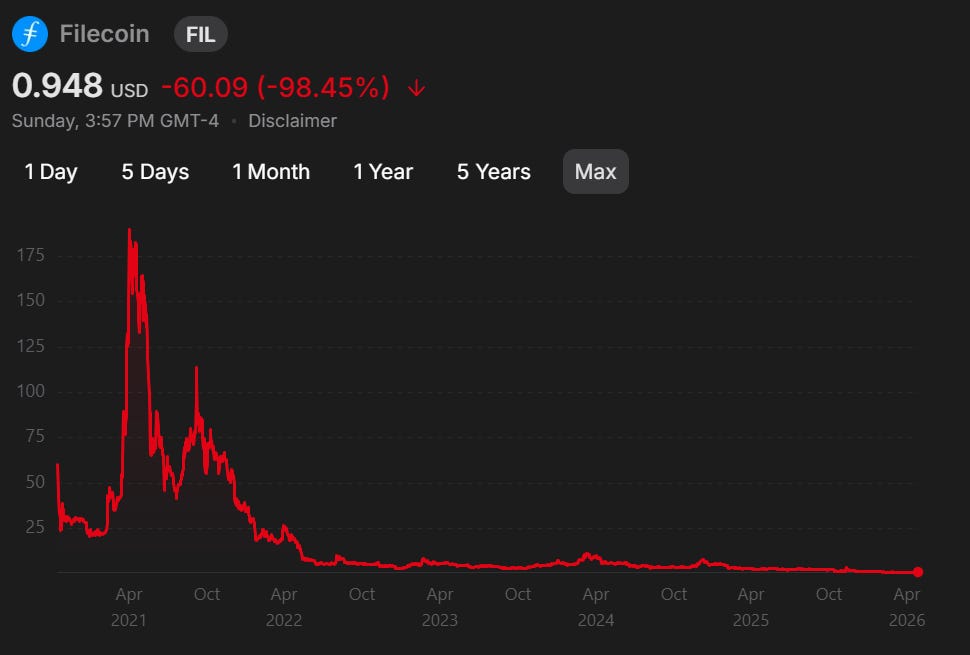
Filecoin is a useful comparison here. Filecoin has an actual infrastructure goal, decentralized storage. Storage providers earn FIL block rewards by contributing storage power to the network, and those rewards are a way to subsidize storage miners for providing reliable and useful storage capacity (Filecoin Docs, 2025; Filecoin, 2020). That is at least a real service model. There is storage, there are providers, there are clients, and the token is supposed to coordinate the system.
But even with Filecoin, the hard question is always whether the network has enough organic demand for the service, or whether the economics depend too heavily on token emissions, speculation, and future expectations. That is the broader lesson. Token incentives can bootstrap activity, but they do not automatically prove durable demand.
That is my concern with DMT-NAT. If the asset is valuable because people actually want NAT for its own sake, then fine, the market can prove that. But if the main purpose is to create something miners can dump to supplement BTC rewards, then I do not see that as a Bitcoin security solution. I see it as a speculative layer wrapped around a real problem.
It reminds me of a whole category of token design that sounds useful at the protocol level but eventually reduces to: Buy this because someone else will need to sell it for the real asset later.
That is not how I want Bitcoin security to be solved.
Bitcoin does not need a second asset whose value depends on people believing it will rescue the first asset. Bitcoin needs more real demand for block space, more efficient mining, more decentralization, more home mining, more heat reuse, and more people directly participating in the network.
A miner reward is only real if someone wants the reward for its own sake. Otherwise, it is just another speculative token trying to borrow Bitcoin’s credibility.
The Math: How Much Home Mining Matters Today
This is where the home mining argument needs to be honest.
A Bitaxe on a desk is not replacing Foundry. A few NerdQaxes in a garage are not suddenly taking over the network. Home mining does not currently replace industrial mining, and pretending otherwise would weaken the argument.
The current Bitcoin network is massive. Bitcoin’s network hashrate was at about 994.76 exahashes per second during the April 3–17, 2026 period (BTC.network, 2026). To put that in normal home miner terms, 994.76 EH/s equals 994,760,000 TH/s. A small home miner running at 6 TH/s would therefore represent:
6 TH/s ÷ 994,760,000 TH/s = 0.000000603% of the network
That is basically nothing at the individual level. This is why solo mining is a lottery. A small miner is not buying predictable yield. They are buying a microscopic chance at a massive outcome.
That is not just theory either. There have been 8 blocks mind from home miners at this point. That totals 25 BTC or >$2 million dollars. The point is not that this will happen to every home miner. It will not. The point is that it can happen at all. Bitcoin mining is brutally competitive, but the door is not completely closed to the individual.
And that is where I think the home mining conversation gets interesting.
If the only framework is industrial profitability, home mining makes no sense. A public mining company thinks in terms of energy contracts, fleet efficiency, uptime, hashprice, debt, hosting agreements, and shareholder expectations. That is one version of mining. It is important, but it is not the only version.
A home miner is playing a different game.
Some people will mine because they want a chance. Some will mine because the machine heats a room. Some will mine because they want to learn how Bitcoin actually works. Some will mine because they already hold Bitcoin and understand that the network securing their wealth should not be left entirely to industrial pools. Some will mine because running a node and pointing hashpower at it is one of the clearest ways to participate in Bitcoin instead of just owning it.
Bitcoin sovereignty has three pillars: hold your own keys, run your own node, and own a miner pointed at that node (Howard, 2026). I like that framing because it moves mining away from just a profit calculation. Self-custody lets you hold your Bitcoin. A full node lets you verify the rules. But mining, even at a tiny scale, lets you participate in block production and censorship resistance. That’s the whole point of Bitcoin.
That does not mean every home miner is changing Bitcoin by themselves. They are not. One 6 TH/s miner is statistically irrelevant against a nearly 995 EH/s network. But that is not the correct scale to think about. The correct question is not “can one home miner beat Foundry?” The answer is obviously no. The better question is “what happens if home mining becomes normal among Bitcoiners?”
If millions of Bitcoin holders each ran small miners, the combined hashrate would no longer be symbolic. If 1% of an estimated 300 million Bitcoin holders ran a 5 TH/s miner, that would equal 15 EH/s of distributed home hashpower (Howard, 2026). That would still be small compared to the entire network, but it would be meaningful compared to many individual pools. At 10%, the number becomes 150 EH/s, which would be a serious decentralizing force (Howard, 2026).
Now, that is not a prediction. I am not saying 30 million people are going to plug in miners tomorrow. But as a direction, it matters. It shows that home mining is not about one guy hitting a block. It is about whether Bitcoiners can create a wider base of non-institutional hashpower over time.
This matters because mining centralization is not only about raw hashrate. It is also about who builds the blocks. When mining pools control block templates, individual miners may provide the hashpower while the pool decides which transactions make it into the block (Howard, 2026). That distinction is huge. If the same few pools or template builders dominate block construction, Bitcoin can become more vulnerable to censorship pressure even if the surface-level hashrate looks distributed.
This is why solo mining and home mining are philosophically important. A solo miner building blocks through their own node has no reason to censor fee-paying transactions. They want the most profitable valid block possible. There is no compliance department. No corporate board. No public company risk team. No pool operator deciding what should or should not be included. There is just the miner, the node, the mempool, and the incentive to include valid transactions that pay fees.
That is the part critics miss when they laugh at home mining as uneconomic. Yes, on a narrow ROI spreadsheet, it is usually terrible. But Bitcoin was not built only by spreadsheet people. It was built by people who understood that financial sovereignty requires participation.
Home mining will not replace industrial mining tomorrow. Industrial miners will still matter because they can access cheap energy, scale quickly, and deploy enormous amounts of hashrate. But home mining can change the decentralization profile. It can create a wider base of independent hashpower. It can make censorship harder. It can make Bitcoin culture more active and less passive. It can turn more Bitcoiners from holders into participants.
That is why I think the home miner matters.
Not because one small miner secures Bitcoin.
Because millions of people choosing to mine, verify, and self-custody would.
The Open-Source Home Mining Movement
This is where the security-budget conversation gets more interesting to me.
Most people still picture Bitcoin mining as giant warehouses, industrial energy contracts, public mining companies, and massive pools. That is part of the reality. Industrial mining exists because scale matters. Cheap electricity matters. Efficient cooling matters. Cost per terahash matters.
But that is not the whole story anymore.
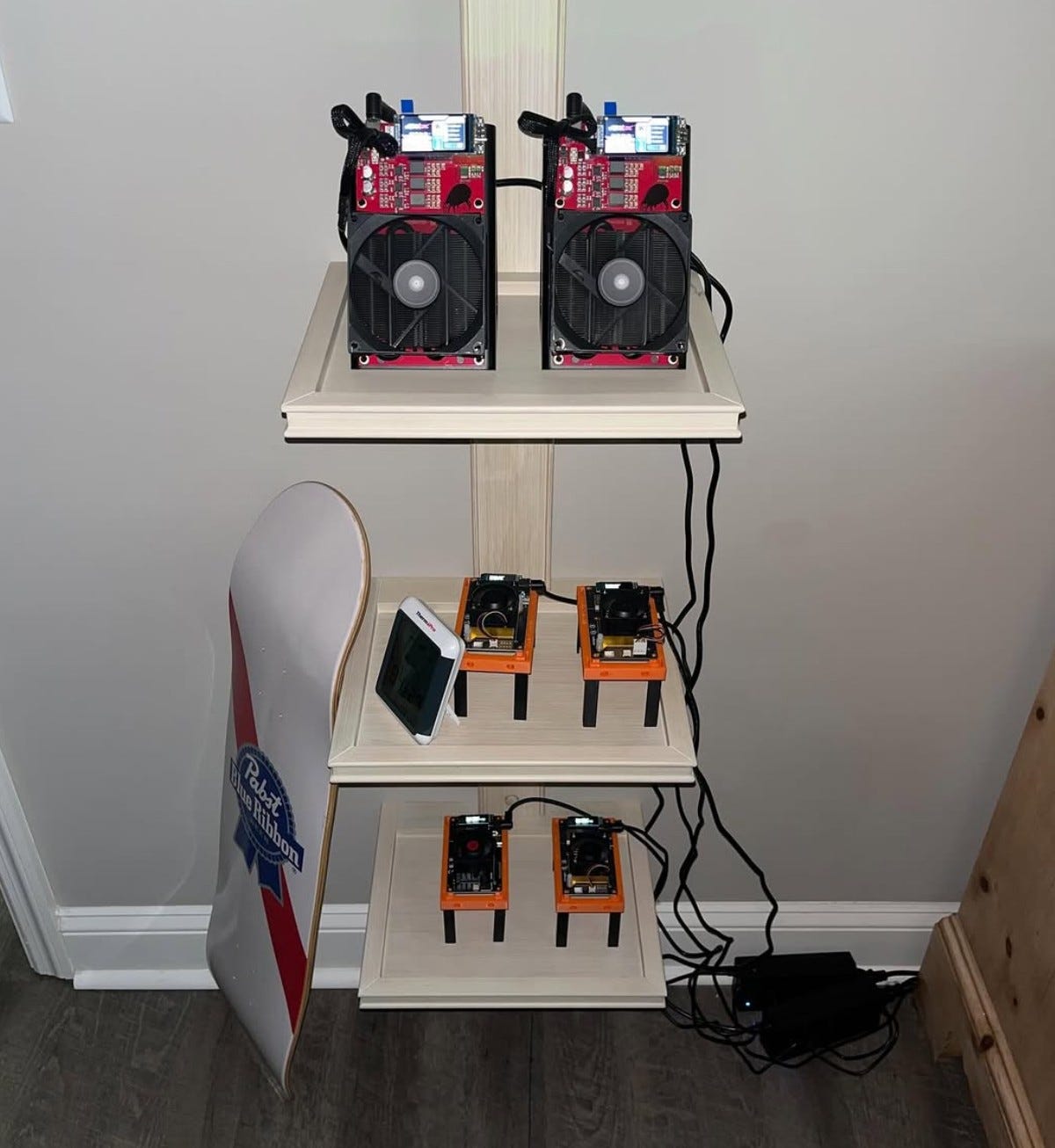
There is now a growing open-source home mining movement built around devices like Bitaxe, NerdQaxe, OSMU-style projects, solo mining, and tools like DATUM. Bitaxe is one of the cleanest examples because it is not trying to pretend it is an industrial miner. It is an open-source Bitcoin miner designed for home use, low power consumption, Wi-Fi operation, and direct participation in the network through solo mining or node-connected setups (Bitaxe, n.d.).
That matters because the home miner is not trying to beat Riot, Marathon, or Foundry on cost per terahash. The home miner is playing a different game.
They are turning mining into a personal sovereignty device.
A Bitaxe on a shelf is a symbol that Bitcoin mining does not have to belong exclusively to industrial warehouses, public companies, pools, and energy contracts. It can exist in a bedroom, office, garage, basement, or dorm room. It can sit next to a node. It can teach someone how blocks are found. It can turn mining from something abstract into something physical.
That may sound small, but Bitcoin culture has always been built this way. Running a node does not make you rich. Holding your own keys does not generate yield. Learning how to verify your own transactions does not show up on a profit-and-loss statement. But all of those things matter because they turn Bitcoin users into Bitcoin participants.
Home mining belongs in that same category.
The next important step is not only getting more people to hash. It is getting more miners to control what they are hashing. This is where DATUM matters. Mining pools originally solved a real problem by making payouts more predictable, but over time they created another problem. Pools, not individual miners, increasingly constructed the block templates and controlled transaction selection (OCEAN, 2024). That is a big deal. If miners provide the hashpower but pools decide what transactions go into blocks, then some of mining’s decentralization is only surface-level.
DATUM tries to push that power back toward miners. DATUM lets miners use a local Bitcoin node for block templates, generate work for mining hardware, and submit solved blocks directly to the network (OCEAN-xyz, 2025). In pooled mining, the pool can still coordinate payouts, but the important distinction is that the pool does not have to be the one creating the miner’s work.
That is the real Bitcoin-native path. Not a second token. Not a speculative miner subsidy. Not another asset that has to be sold for BTC. The better answer is miners reclaiming block construction.
This is why home mining, solo mining, and DATUM all connect to the security-budget debate. The question shifts from “how much are miners paid?” to “who are the miners, who builds the blocks, and how many people can realistically participate?”
If the future of Bitcoin mining is only a handful of industrial players pointed at a handful of pools, then the network may still have a massive hashrate, but it becomes culturally and politically weaker. If the future includes home miners, heat miners, solo miners, node runners, and miners building their own templates, then the security model becomes harder to capture.
That is what I want to see.
The goal is not to make every home miner profitable in the same way an industrial miner tries to be profitable. The goal is to make mining more normal, more distributed, more understandable, and more connected to the people who actually care about Bitcoin surviving long term.
Heat Reuse: the Overlooked Subsidy
Bitcoin mining does not have to waste heat if the heat is the product.
The security-budget debate usually treats mining cost as pure waste. Electricity goes in. Hashes come out. Heat is a problem that has to be removed. That is mostly how industrial mining works. If you are running a warehouse full of ASICs in Texas, the heat is something you have to manage, vent, cool, or dump.
But at the home level, the logic changes.
Mining converts electricity into hashes and heat. If you do not need the heat, then the heat feels wasted. But if you do need the heat, then the miner is also a heater that happens to produce Bitcoin.
Braiins has an entire book on Bitcoin mining heat reuse, and it describes this emerging category as hashrate heating, where ASICs are repurposed or designed to provide useful heat for consumers (Stevens, n.d.). Bitcoin mining heat can be repurposed for homes and food production, potentially lowering heating costs and reducing emissions when it offsets other heating sources (Jaran Mellerud, 2022). The idea is simple. If you were already going to pay for heat, then mining can turn part of that heating bill into hashrate.
That does not make mining free or make every miner profitable, but it does change the real cost calculation.
A normal mining spreadsheet looks like this:
electricity in → BTC out
A heat-reuse mining spreadsheet looks more like this:
electricity in → BTC lottery ticket + useful heat out
In a home, garage, greenhouse, water heater, basement, 3D-printing room, or workshop, heat is not always a liability. Sometimes it is the exact thing you were already paying for. If a miner offsets space heating, water heating, drying, greenhouse heating, or some other heat demand, then the miner’s real economic burden is lower than it looks on a basic mining calculator.
This is why I think heat reuse belongs in the security-budget conversation. It gives some miners a reason to keep mining even when pure mining profitability is weak. A public mining company may shut off when hashprice drops below its cost structure. A home miner using the machine as a heater may think differently because the heat itself has value.
We are already seeing examples of this idea move from theory into products and prototypes. There have been 3D printer prototypes that use Bitcoin mining ASIC heat to warm the print bed, with the printer bed acting as a heatsink (Tom’s Hardware, 2026a). Another report covered a Bitcoin-mining water heater concept that uses heat from integrated mining hardware to warm water, with the company claiming it can offset a major portion of household water-heating costs (Tom’s Hardware, 2026b). Those claims still need to be proven in the real world, but the direction is important.
The future of mining is not bigger warehouses. It is smaller machines embedded into normal life. A miner can be a heater. A miner can warm water. A miner can stabilize a print bed. A miner can heat a greenhouse. A miner can sit in a basement and make a room useful in the winter. That changes the shape of the security-budget problem.
Because now some miners are not only mining for BTC.
They are mining for heat, sovereignty, learning, lottery exposure, and participation.
That is much harder to model than industrial ROI, but Bitcoin has always had a human layer that models miss. People run nodes that do not pay them. People self-custody even when exchanges are easier. People solo mine even when the odds are against them. People build open-source miners even when closed industrial hardware dominates the market. Heat reuse fits that same pattern.
It turns mining from an abstract industrial activity into something ordinary people can actually use. And if mining becomes useful inside homes, garages, workshops, greenhouses, and appliances, then Bitcoin’s security future looks very different from a simple chart showing the subsidy going down.
The subsidy declines. That is true.
But the ways people can mine, use heat, build blocks, and participate are not frozen in time.
Moore’s Law, Chips, and the Common Device Future
This is another place where I think the argument has to be careful.
I do not think Moore’s Law magically solves Bitcoin’s security budget. Better chips do not make mining easy, guarantee profit, or remove competition. Bitcoin has a difficulty adjustment for this exact reason. Every 2,016 blocks, the network adjusts difficulty so that blocks continue to arrive at roughly the target pace, even as hashrate changes (Bitcoin Developer Guide, n.d.). So if mining hardware gets better and more hashrate comes online, difficulty eventually adjusts.
Better chips do not eliminate mining competition. They lower the barrier for participation.
Moore’s Law comes from Gordon Moore’s 1965 observation that the number of components on integrated circuits had been increasing rapidly, which became the idea that computing power improves dramatically over time while cost per unit of computation falls (Moore, 1965). Bitcoin mining is not general-purpose computing anymore. It is specialized ASIC competition. So I am not saying that your phone is suddenly going to outmine an Antminer, or that every household device will become profitable in the industrial mining sense… But the broader technology trend still matters.
As chips become more efficient, smaller, quieter, cooler, and easier to integrate, mining does not have to stay trapped in the industrial warehouse model. It can move into appliances, heaters, garages, home servers, workshops, water systems, and other devices that people already use. Difficulty will still adjust. Competition will still exist. But participation can broaden.
The security-budget debate often treats mining like it will always look exactly like it does today with giant sites, large pools, public companies, energy contracts, and professional operators. Some of that will stay true but it is a mistake to assume that mining hardware, home energy use, heat reuse, and open-source mining culture are frozen in place.
A future miner does not have to look like a black metal box screaming in a warehouse. It could look like a heater. It could look like a water heater. It could look like a home server. It could look like a device in the garage that runs quietly and produces useful heat. It could be something that a person buys for sovereignty, lottery exposure, and utility, not just clean ROI.
The path to mining will continue to become exponentially easier.
And that matters because Bitcoin security is not about the biggest miners getting bigger. It is about how many people can realistically participate at the edges. The edges are where culture lives. They are where experimentation happens. They are where open-source hardware gets built, tested, improved, and normalized.
That is what the fear-based security-budget model has trouble capturing.
It can model subsidy decline. It can model fees. It can model hashrate. It can model miner revenue. But it has a harder time modeling culture, tinkering, open-source hardware, ideology, and the fact that some people will mine even when Wall Street would tell them not to.
The future I see is not one where Bitcoin mining becomes easy. It is one where Bitcoin mining becomes more normal.
Normal does not mean guaranteed profitable. Normal means a person can understand it, buy it, run it, point it at their node, reuse the heat, and participate without needing a warehouse or a power-purchase agreement. That is a very different future than one where Bitcoin security is outsourced entirely to industrial miners and a few giant pools.
The Future Security Model
Bitcoin’s future miner incentive model will not be one single thing. It will be messy and that is exactly why it will work.
By the time the block reward becomes a serious issue, Bitcoin will not look like it does today. That is the part I think most of the security-budget panic misses. It assumes the subsidy keeps falling while the rest of the world stands still. I do not believe that is what will happen.
I think Bitcoin will be adopted at a much larger scale. I think daily payments will move through Lightning and other Bitcoin layers. I think the base chain will be used for large settlement, serious money, cold storage, institutional movement, channel opens and closes, inheritance, treasury management, and transactions that actually deserve final settlement on the strongest monetary network in the world. That is where base-layer fees come from.
People do not need to buy coffee on-chain. They do not need every small payment permanently written to the base layer. That is not the purpose of the Bitcoin blockchain. The base chain is for final settlement. Lightning and other layers are for everyday movement. That separation makes sense. Small payments can happen fast and cheap. Large transactions can pay real fees for real settlement.
The bigger change is that mining will become integrated into normal life.
I do not think the future of Bitcoin mining is only giant warehouses, public mining companies, and industrial energy deals. That model eventually gets replaced by cheap, easy, common home miners that are built into everyday life. Mining will not feel like some weird technical hobby forever. It will become normal. It will be in heaters, garages, water systems, appliances, home servers, workshops, greenhouses, and devices people already use.
Most people will not think about it the way miners think about it today. They will not be calculating hashprice every morning. They will not be trying to beat industrial miners on cost per terahash. They will just have mining built into something useful. A heater that mines. A device in the garage that mines. A home server that mines. A household appliance that quietly participates in the Bitcoin network while doing something else useful.
Mining will become seamless.
That is the future I see.
The incentive will not be “can I make a profit this month?” The incentive will be, “I use this global permissionless money, so I want to help secure it. I want a lottery chance at a block. I want useful heat. I want sovereignty. I want my home to participate in the network. I want the money I use to be protected by millions of people around the world instead of a narrow class of industrial operators.”
That is a completely different security model than the one people are used to discussing.
Industrial miners dominate today because they have scale, cheap power, access to capital, and professional operations. That dominance will not last forever. As ASICs get smaller, cheaper, quieter, and easier to integrate, the advantage starts to shift. Industrial miners will not disappear overnight, but their role will shrink as mining becomes something normal people can do without thinking about it.
The future miner is not only a company.
The future miner is a device that someone owns because it is useful even before the Bitcoin lottery ticket is counted.
That is why I do not like the idea that Bitcoin needs another token to solve this. A second asset is the wrong mental model. Bitcoin does not need NAT to pay miners. Bitcoin needs Bitcoiners to mine. It needs people to become part of the security model directly and that will happen when participation becomes easy enough.
Right now, home mining is still early and is still mostly done by people who already care deeply about Bitcoin. Running a node used to feel extreme. Self-custody used to feel extreme. Lightning used to feel experimental. Home mining feels that way now, but it wont stay that way forever.
As Bitcoin becomes more important, people will care more about securing it. The more wealth stored in Bitcoin, the stronger the incentive becomes to protect the network. If Bitcoin becomes global permissionless money, then the reason to mine is not just profit. The reason to mine is to protect the monetary system you actually use.
People will mine because the network matters.
They will mine because Bitcoin is their savings.
They will mine because Bitcoin is their payment rail.
They will mine because Bitcoin is their escape hatch.
They will mine because Bitcoin is the global money that no government, bank, company, or committee can control.
And when that is the thing being protected, mining is no longer just an industrial business. It becomes civic participation in a permissionless monetary network.
The future is millions of people using Bitcoin, verifying Bitcoin, transacting on Lightning, settling serious value on-chain, and securing the network through miners that become cheap, normal, and integrated into everyday life.
Enter as a reader; leave as an operator. Subscribe, custody, protect the signal.
-WD
Sources
Budish, E. (2018). The economic limits of Bitcoin and the blockchain (NBER Working Paper No. 24717). National Bureau of Economic Research. https://www.nber.org/papers/w24717
CoinMarketCap. (2026). Bitcoin price today. https://coinmarketcap.com/currencies/bitcoin/
D-Central Technologies. (2026). Bitcoin transaction fee calculation: The complete guide. https://d-central.tech/how-are-bitcoin-transaction-fees-calculated/
Bitcoin’s security budget issue: Problems, solutions & myths. (n.d.). https://budget.day/
BTC.network. (2026, April 23). Bitcoin block space report: April 16–23, 2026. https://btc.network/blog/bitcoin-block-space-report-april-16-23-2026
Czech National Bank. (2025). Analysis of possible investment in other asset classes: Part I: Digital assets. https://www.cnb.cz/export/sites/cnb/en/economic-research/.galleries/cnb_lab/digital-assets-pilot/analysis_of_possible_investment_in_other_asset_classes_part_i_digital_assets.pdf
CoinMarketCap. (2026). DMT-NAT price today, NAT to USD live price, market cap and chart. https://coinmarketcap.com/currencies/nat/
DMT-NAT: Bitcoin’s second miner subsidy to address the declining security budget. (n.d.). https://natgmi.com/
Filecoin. (2020, October 12). Filecoin features: Block rewards. https://filecoin.io/blog/posts/filecoin-features-block-rewards/
Filecoin Docs. (2025, April 10). Block rewards. https://docs.filecoin.io/storage-providers/filecoin-economics/block-rewards
f2pool. (2026). DMT-NAT (NAT) launching soon. https://f2pool.zendesk.com/hc/en-us/articles/57254178091417-DMT-NAT-NAT-launching-soon
BTC.network. (2026, April 17). Bitcoin mining & hashrate report: April 3–17, 2026 — Network holds near 995 EH/s ahead of imminent difficulty adjustment. https://btc.network/blog/bitcoin-mining-hashrate-report-april-3-17-2026
Howard, M. (2026, March 24). The cheapest fight for freedom in human history. Matt’s Substack. https://solosatoshiofficial.substack.com/p/the-cheapest-fight-for-freedom-in
Tom’s Hardware. (2025, November 21). Hobbyist solo miner scores a full Bitcoin block worth $270,000 despite 1 in 180 million odds. https://www.tomshardware.com/tech-industry/cryptomining/hobbyist-miner-using-a-single-6-ths-asic-mines-full-bitcoin-block
Bitaxe. (n.d.). Bitaxe: Open source Bitcoin miner. https://bitaxe.org/
Jaran Mellerud. (2022, September 18). Repurposing waste heat from bitcoin mining can lower heating costs and mitigate emissions. K33 Research. https://k33.com/research/archive/articles/repurposing-waste-heat-from-bitcoin-mining-can-lower-heating-costs-and
OCEAN. (2024, September 29). The origins of DATUM. https://ocean.xyz/docs/datum
OCEAN-xyz. (2025). DATUM Gateway. GitHub. https://github.com/OCEAN-xyz/datum_gateway
Stevens, T. (n.d.). Bitcoin mining heat reuse. Braiins. https://braiins.com/books/bitcoin-mining-heat-reuse
Tom’s Hardware. (2026a, March 9). 3D printer that can mine Bitcoin uses excess heat for temperature control — throttled ASICs use printing bed as a heatsink. https://www.tomshardware.com/tech-industry/cryptomining/3d-printer-that-can-mine-bitcoin-uses-excess-heat-for-temperature-control-throttled-asics-use-printing-bed-as-a-heatsink
Tom’s Hardware. (2026b, January 18). This $2,000 Bitcoin mining water heater can pay for itself by slashing your energy bills, company claims. https://www.tomshardware.com/tech-industry/cryptomining/bitcoin-mining-water-heater-firm-says-its-usd2-000-product-can-rake-back-usd1-000-a-year-in-btc-and-claims-it-can-offset-up-to-80-percent-of-electricity-and-water-costs
Bitcoin Developer Guide. (n.d.). Block chain. https://developer.bitcoin.org/devguide/block_chain.html
Moore, G. E. (1965). Cramming more components onto integrated circuits. Electronics, 38(8), 114–117. https://www.cs.utexas.edu/~fussell/courses/cs352h/papers/moore.pdf
Reed, D. P. (2001). The law of the pack. Harvard Business Review, 79(2), 23–24. https://hbr.org/2001/02/the-law-of-the-pac